



Ligaments are strong bands of connective tissue that connect bones and help stabilize joints during everyday movements and physical activities. Ligament injuries are common among athletes, active individuals, and people who experience sudden twisting, falls, or direct impact. Understanding ligament tear symptoms, diagnosis, treatment, and recovery can help people seek appropriate medical care at the right time.
Causes of Ligament Tear
The causes of ligament tear can vary depending on the affected joint and the activity involved. Sudden changes in direction, awkward landings, falls, collisions, and excessive twisting can place significant stress on a ligament. Sports-related ligament injuries are particularly common in activities such as football, cricket, basketball, running, and other sports that involve jumping or rapid movements. A knee ligament tear may affect important structures such as the ACL. An ACL ligament tear commonly occurs when the knee twists suddenly, while a PCL ligament tear can result from a forceful impact to the front of the knee or other significant trauma.
Ligament Tear Symptoms
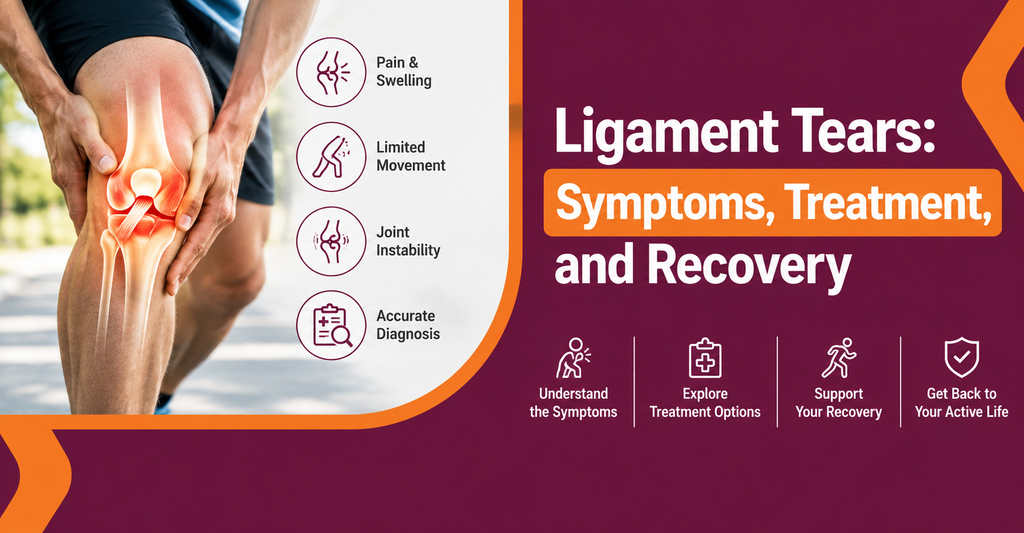
Recognizing ligament tear symptoms can help patients seek timely evaluation. Common symptoms of torn ligament include pain, swelling, tenderness, bruising, restricted movement, and difficulty putting weight on the affected joint. Some people may hear or feel a popping sensation at the time of injury. A feeling of instability or the joint “giving way” may also occur, particularly with certain knee ligament injuries.
Ligament Tear Diagnosis
A physical examination is an important part of ligament tear diagnosis. An orthopedic specialist may assess pain, swelling, joint movement, stability, and the mechanism of injury. Depending on the suspected ligament damage, imaging may be recommended. X-rays can help identify associated bone injuries, while an MRI for ligament tear can provide detailed images of soft tissues and help assess the extent of the injury. Accurate diagnosis helps determine the most suitable treatment approach.
Ligament Tear Treatment
The appropriate ligament tear treatment depends on the location and severity of the injury, the patient’s age, activity level, and overall joint stability. Mild injuries may improve with rest, ice, compression, elevation, activity modification, and supervised physiotherapy. Non-surgical ligament tear treatment may be suitable for selected partial tears or injuries where the joint remains stable. A structured rehabilitation program can help restore strength, flexibility, balance, and joint function.
For certain complete tears or injuries associated with significant instability, ligament tear surgery may be considered. Ligament reconstruction surgery can help restore stability when a damaged ligament cannot adequately heal or function. In appropriate cases, arthroscopic ligament surgery uses small incisions and specialized instruments to treat certain knee ligament injuries.
Ligament Tear Recovery
Ligament tear recovery varies from person to person. The ligament tear recovery time depends on factors such as the type and severity of the tear, treatment method, age, general health, and adherence to rehabilitation. Following surgery, recovery usually involves several stages of physiotherapy and gradual return to normal activities. Exercises for ligament recovery may include range-of-motion exercises, strengthening, balance training, and functional exercises, depending on the stage of rehabilitation. Patients should follow their orthopedic specialist’s recommendations and avoid returning to strenuous activities too quickly.
Conclusion
A ligament injury can affect mobility, joint stability, and daily activities, but timely diagnosis and appropriate treatment can support a safe recovery. Whether it involves an ACL ligament tear or another torn ligament, understanding the symptoms and available treatment options is important. For professional evaluation and personalized care, patients can consult Dr. Madhu Reddy (orthopedic surgeon) at M&M Ortho Hospital can help patients understand their ankle injury and choose suitable treatment based on its severity. With timely care, appropriate exercises, and preventive measures, most patients can work toward restoring ankle strength, mobility, and confidence in everyday activities.